



| Quantity: | |
|---|---|


First, the main types and performance comparison
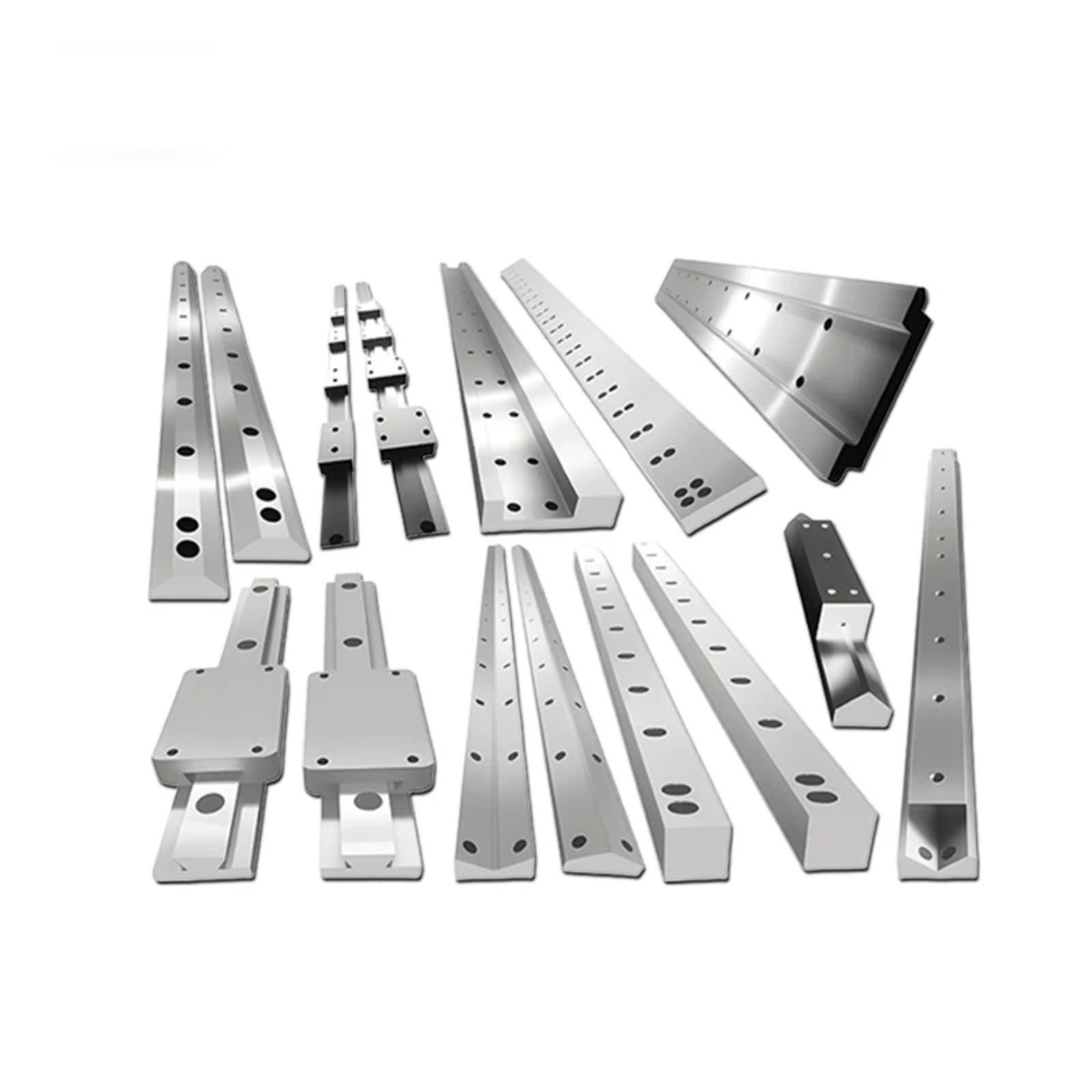
1. Sliding Guide (Hard Rail/Box Way)
Principle: The guide rail surface is directly in contact with sliding, which belongs to sliding friction (friction coefficient 0.05 to 0.2).
Advantages: strong rigidity, large load-bearing capacity; good vibration resistance and damping, suitable for heavy cutting and large impact force conditions; simple structure, mature process and low cost.
Disadvantages: high friction, easy to crawl at low speed, fast wear and tear, limited speed, frequent maintenance.
Common structures: rectangle, triangle, dovetail.
Representative subdivision: cast iron guide rails (HT200/HT300) are common to ordinary machine tools; plastic guide rails (Turcite-B/PTFE soft belt) have friction reduced to 0.04, which is anti-crawling; steel guide rails are inlaid with high hardness steel strips, which are extremely wear-resistant.
Applicable scenarios: heavy gantry milling, vertical lathe, die machine, heavy cutting machining center.
2. Rolling Guide (Line Rail/Linear Guide)
Principle: There is a ball/roller cycle rolling between the guide rail and the slider, which belongs to rolling friction (friction coefficient 0.001 to 0.003).
Advantages: minimal friction, sensitive motion, no crawling at high speed; high positioning accuracy (repeated positioning ± 1μm), low wear, long life; standardization, easy installation and maintenance, low energy consumption.
Disadvantages: rigidity and vibration resistance are weaker than hard rails, and heavy loads are prone to deformation.
Classification: ball guide point contact, fast speed, high precision, light and medium load; roller guide line contact, stronger rigidity and load, heavy-duty precision machine tools.
Applicable scenarios: high-speed machining centers, numerical control lathes, 3C precision machine tools, automation equipment.
Second, commonly used guide materials
Cast iron (HT200/HT250/HT300): low cost, good vibration absorption, for ordinary sliding guide rails.
Wear-resistant cast iron (high phosphorus, vanadium and titanium): the wear resistance is increased by 30% to 50%, and the surface is quenched HRC45-50.
Hardened steel (45 steel, GCr15, CrWMn): HRC58-62, used for rolling rails, steel inlaid rails.
Non-ferrous metals (bronze, aluminum bronze): low friction, anti-bite, for sliding rail pairing.
Engineering plastics (PTFE-based soft belt): μ Technologies 0.04, self-lubricating, anti-crawling, plastic guide rail mainstream.
Composite materials (CFRP, cermet): lightweight, low thermal expansion, high wear resistance, high-end applications.
III. Core technical requirements
Guidance accuracy: straightness precision level ≤ 0.005mm/m, ultra-precision level nanometer level; parallelism and verticality ensure stable posture of moving parts.
Rigidity: the ability to resist cutting forces, self-weight, and partial loads, which directly affects machining accuracy and stability.
Wear resistance: maintain accuracy for a long time, reduce wear and tear, extend lifespan, and reduce maintenance.
Friction characteristics: the difference between static and dynamic friction coefficients is small, preventing low-speed crawling.
Lubrication and protection: reliable lubrication (oil/grease), dustproof and chip-proof, prolonging life.
IV. Selection points
Heavy cutting, heavy load, strong vibration → sliding guide (hard rail)
High-speed, high-precision, high-efficiency, light and medium-load → rolling guide rail (line rail)